Gorilla trekking was an optional excursion on our birding trip and, for me anyway, was not the main purpose of going Uganda.
But now having done the trek to see the Gorillas, I would not have missed it for the world.
It ranks as one of my top, most memorable and incredible wildlife experiences.
Bwindi Impenetrable Forest
Bwindi NP is in the very far South-west corner of Uganda, bordering both the DRC and Rwanda.
This national park is covered in ancient, prime forest in a very mountainous terrain. It is only 320 square kms, but is a critical part of the effort to preserve the mountain gorillas. Over 50% of the world’s remaining mountain gorillas are in Bwindi NP.
There are, in addition, 120 other mammal species, including chimpanzees, as well as over 350 bird species in Bwindi NP.
In fact, for the first two days in Bwindi NP we spent many fruitful hours birding and saw an incredible number of unique bird species, which I will write about separately.
For the birder, Bwindi NP is one of the top birding destinations in Uganda and, perhaps, in the whole of Africa.
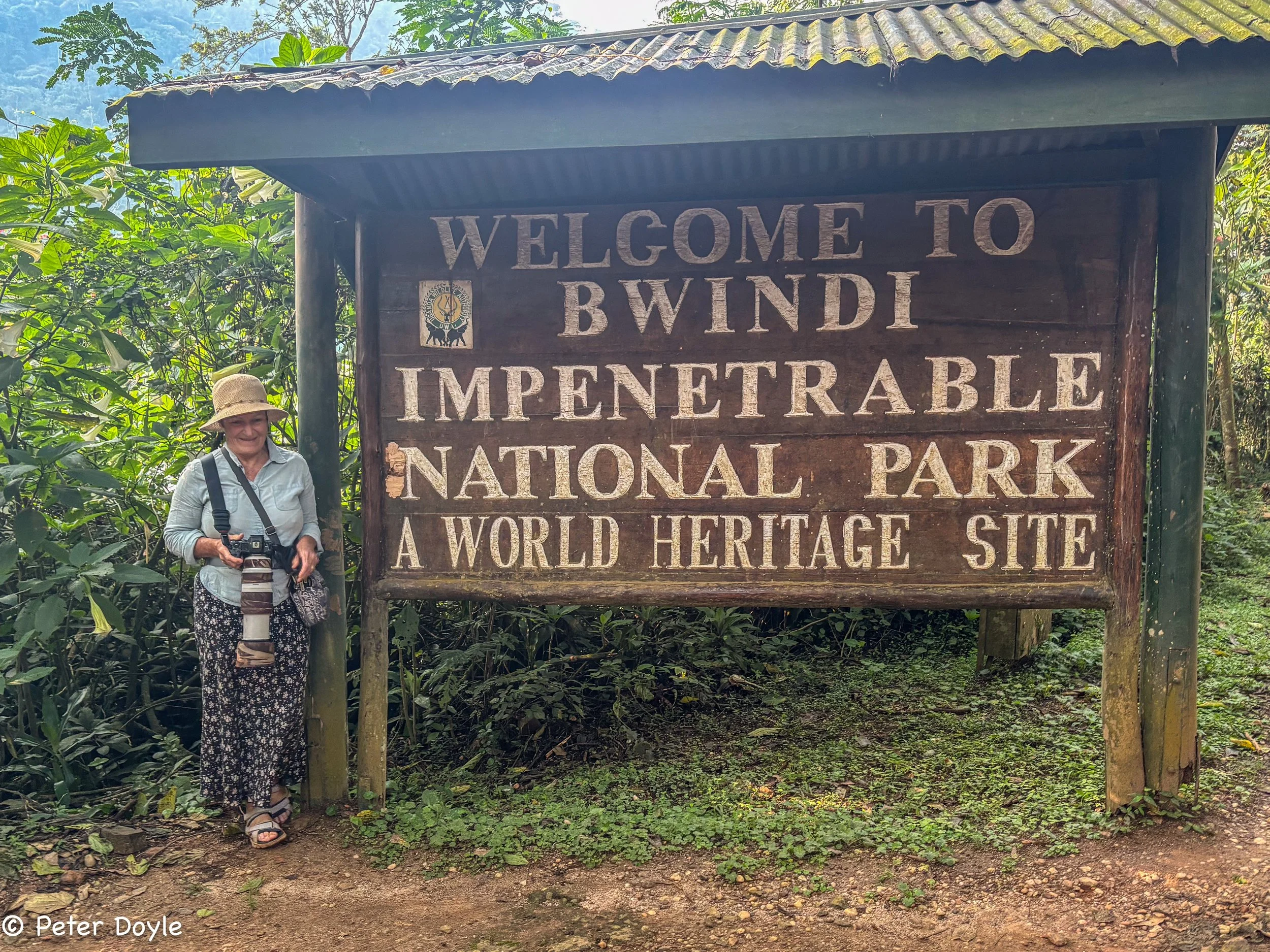
Elle at the entrance to the Bwindi Impenetrable National Park
Mountain Gorilla Conservation
The story about the conservation of the gorillas is nearly as interesting as seeing the gorillas themselves.
The local Ugandan people take great pride in their country and especially the preservation of the gorillas.
Bwindi NP was established as a national park only in 1991 and a UNESCO World Heritage Site in 1994.
The nearby hills and even mountain slopes are farmed and forested intensively. There is no doubt that the continued existence of these wild mountain gorillas and their habitat is only due to the very impressive conservation effort of the Uganda Wildlife Authority. (UWA).
There are now over 500 mountain gorillas in Bwindi NP, up from about 300 in 1991.
Conservation efforts include monitoring and research, veterinary and health services, anti-poaching, prevention of deforestation, responsible ecotourism and community-based conservation.
Of all these efforts, it seems that the involvement of the local communities is one of the most critical aspects of conservation. Local communities clearly benefit from the presence of the gorillas and these benefits extends to health services and economic activity, much of this funded by ecotourism.
Gorilla Trekking
The day’s trekking starts out at the gorilla centre run by the UWA.
First up is some local singing and dancing … we even got to see some South Africans up on the dance floor … and all the tourists got a taste of some local African rhythm, which must obviously help the trekking!
There followed a briefing to all the trekkers. I was surprised how many we were, probably about 55 people that day. But the logistics makes complete sense and was explained as follows.
Of the 35 gorilla family groups in Bwindi, only about 20 families are habituated to humans. That means that local trackers are out tracking each of these groups most days, and so they are also the families followed and observed by both researchers and ecotourists.
So in that sense, they are “habituated”, meaning they do not disappear when they see humans, but in all other respects they are still wild and live fully in the wild.
Each family group has typically 10 to 25 members. It almost always consists of one dominant male Silverback, some other subordinate Black-back males, or even an older subordinate Silverback male; and of course the adult females and their offspring being infants and juveniles.
On our trek that day, we were fortunate to see a family group with all these types of family members present and interacting.
The ecotourists (us!), the “trekkers”, are split into groups of no more than 8 people. This was exactly our group size, so we were all in a group together. Each group are then allocated an experienced UWA guide.
Furthermore each group and their guide are allocated to a specific gorilla family for that day’s trekking. We were assigned to track the Rukara Group.
Visits to the gorillas are limited to only one hour, after you find your allocated family. So that means that each family group will only see 8 trekkers per day, for only one hour, and only a few times per week.
So far so good. The question now became how to find you gorilla family? In an impenetrable forest, after all!
Our tracking experience
It is, of course, your guide that finds the gorillas for you.
Our excellent guide was Phoebe, a young lady, from the district, trained by the UWA. Once in the forest, she also briefed on the finer details of trekking and especially how to behave once we came into contact with the Gorillas.
Phoebe stayed in mobile phone contact with the trackers, who had already been out since early morning, tracking our allocated family.
So it is just a question of staying in contact with the trackers. Easier said than done!
Trekking to the gorillas and back can take up to 6 hours, or even up to 8 hours. It all depends where they are and how fast they are moving. The gorillas move remarkably quickly through the forest and over mountainous terrain in search of food. And just don’t expect roads or paths in the forest … there aren’t any.
One thing I leaned that day, gorillas go where they please!
Phoebe initially told us to wait, because the Rukara group were moving too quickly. Then, as we started to approach the area they were in, we heard a huge commotion, as a fight had apparently broken out between “our” family and another wild group.
This was a territorial battle and it meant that we could not then approach the Rukara Group, because of the levels of aggression and agitation in both groups. And we did not want to accidentally run into the wild group!
After waiting nearly an hour, the trackers advised us it was safe to approach, although the gorillas had moved a distance further away. What followed was a rock ‘n roll through the dense forest, including some of us tumbling down steep slopes into a small valley.
Mobile phone signal was lost, and Phoebe and the trackers had to resort to “cooo-eeing” to find each other and take us in the right direction.
Suddenly Phoebe told us to stop and put on our face-masks, reminding us all of the Covid days. The masks are to protect the gorillas from human diseases.
We froze and waited. We saw nothing and had heard nothing.
But Phoebe just said “they are here”.
The next moment the gorillas emerged out of the dense forest, all around us, and walked nonchalantly past into a kind of clearing ahead, where many of them sat down to feed.
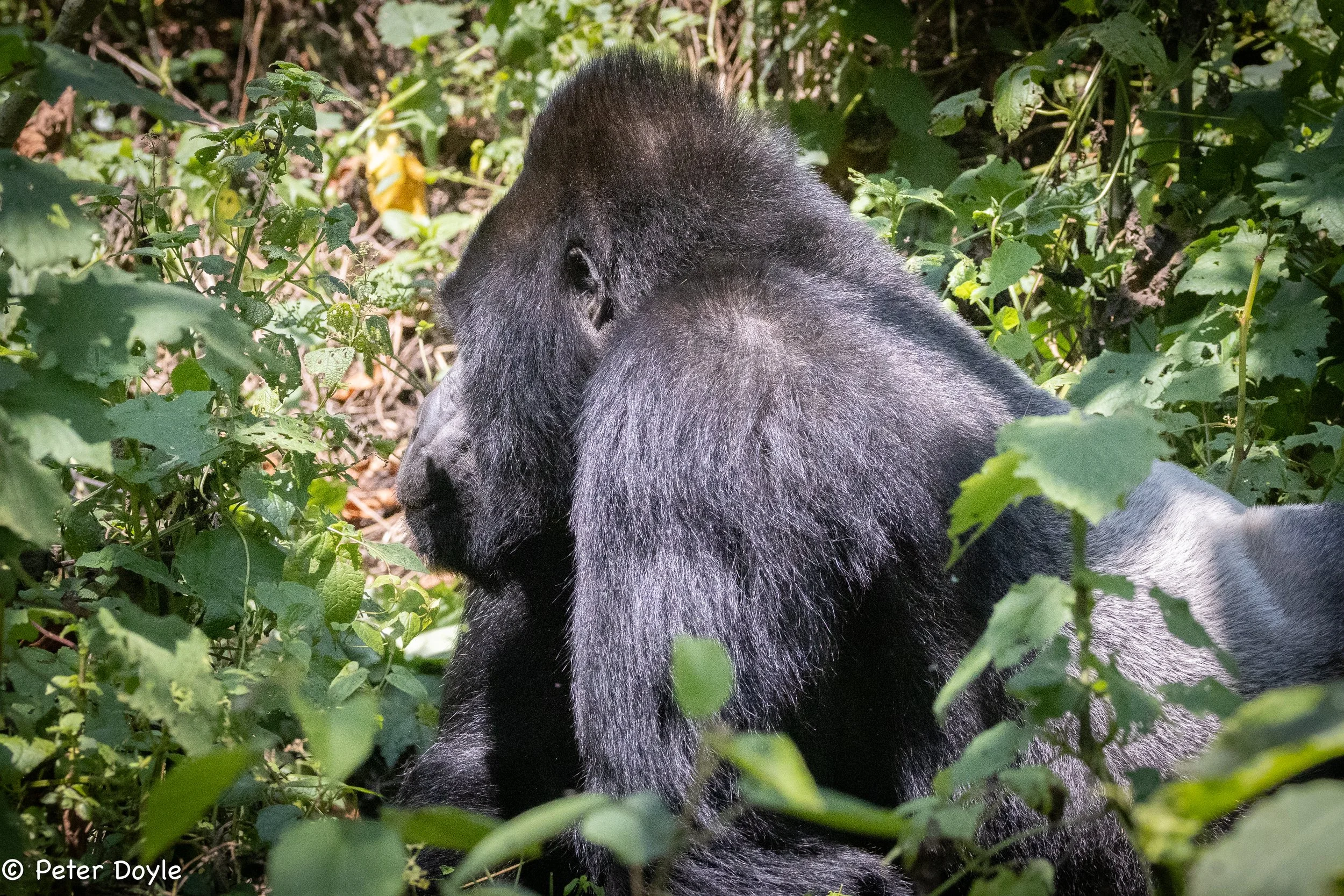
Any trepidation we felt just evaporated when we saw them. We were careful to stay out of their way and, of course, we had been instructed not to approach them.
Most of us just sat down in the bushes and for the next hour or so watched, enthralled, as the gorilla family went about their business, ignoring us almost entirely.
Some of the males, including an old Silverback, had fresh wounds from their earlier skirmish with the wild group.
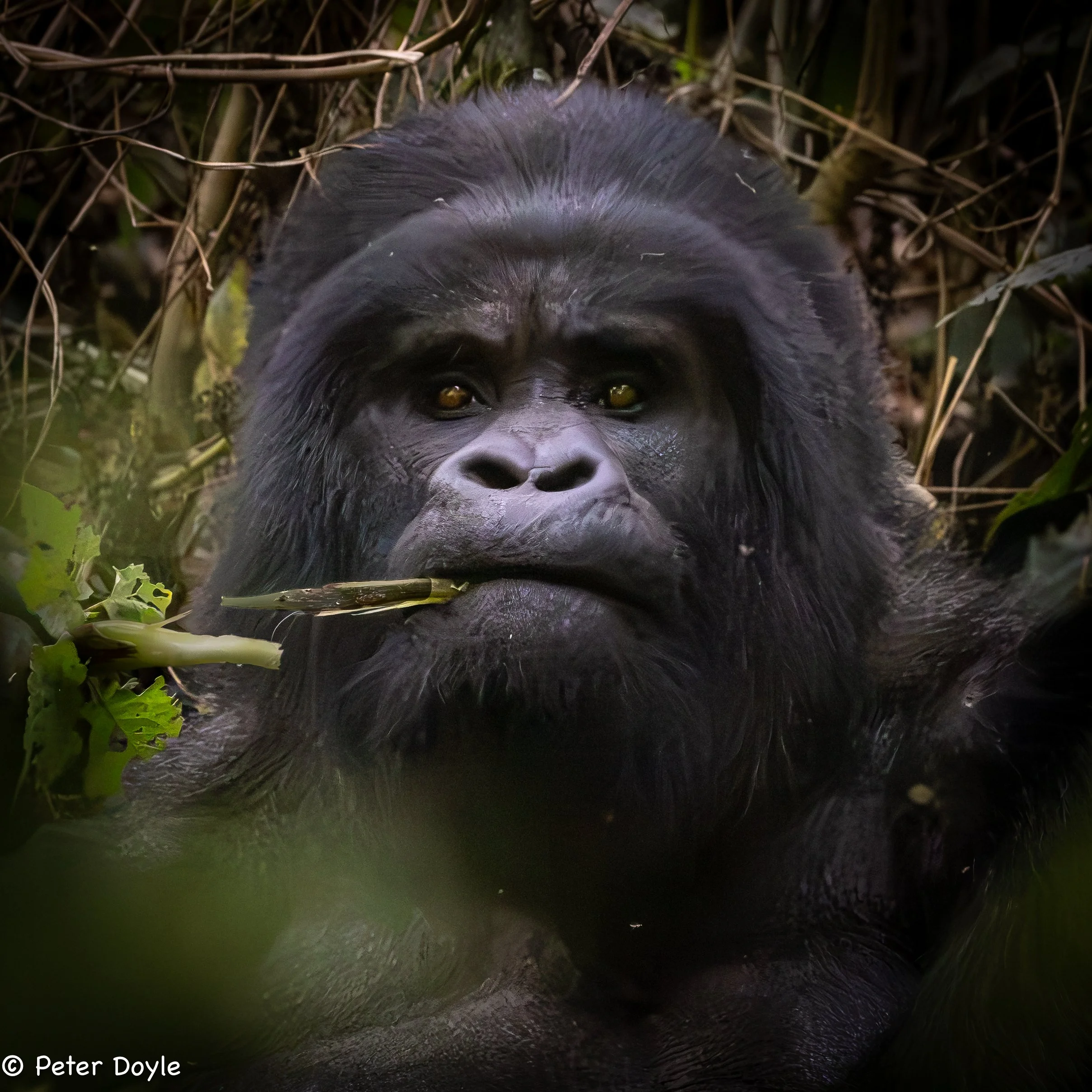
It was very clear which one was the dominant male Silverback … he had a silver back, his behaviour was dominant; and he was huge!
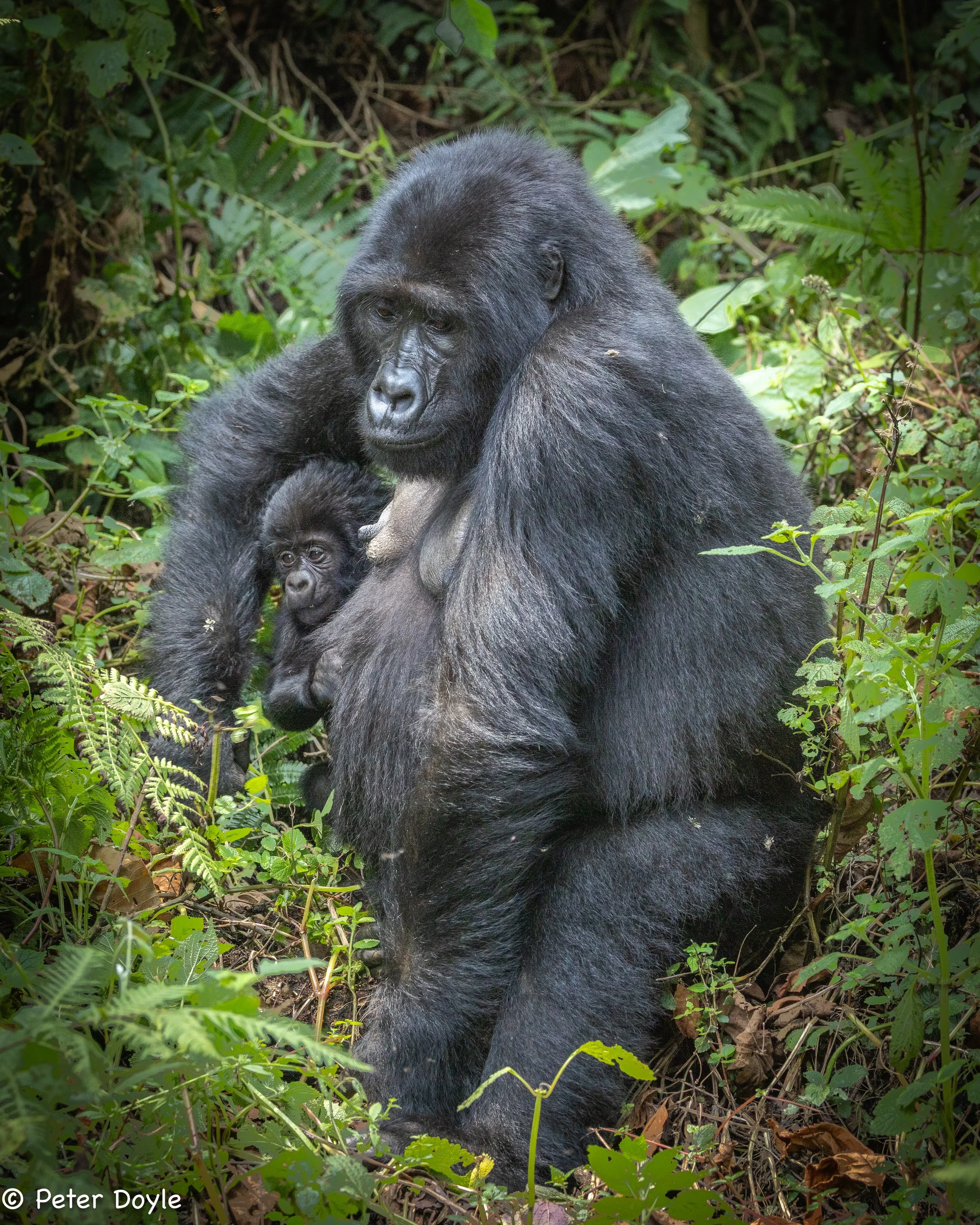
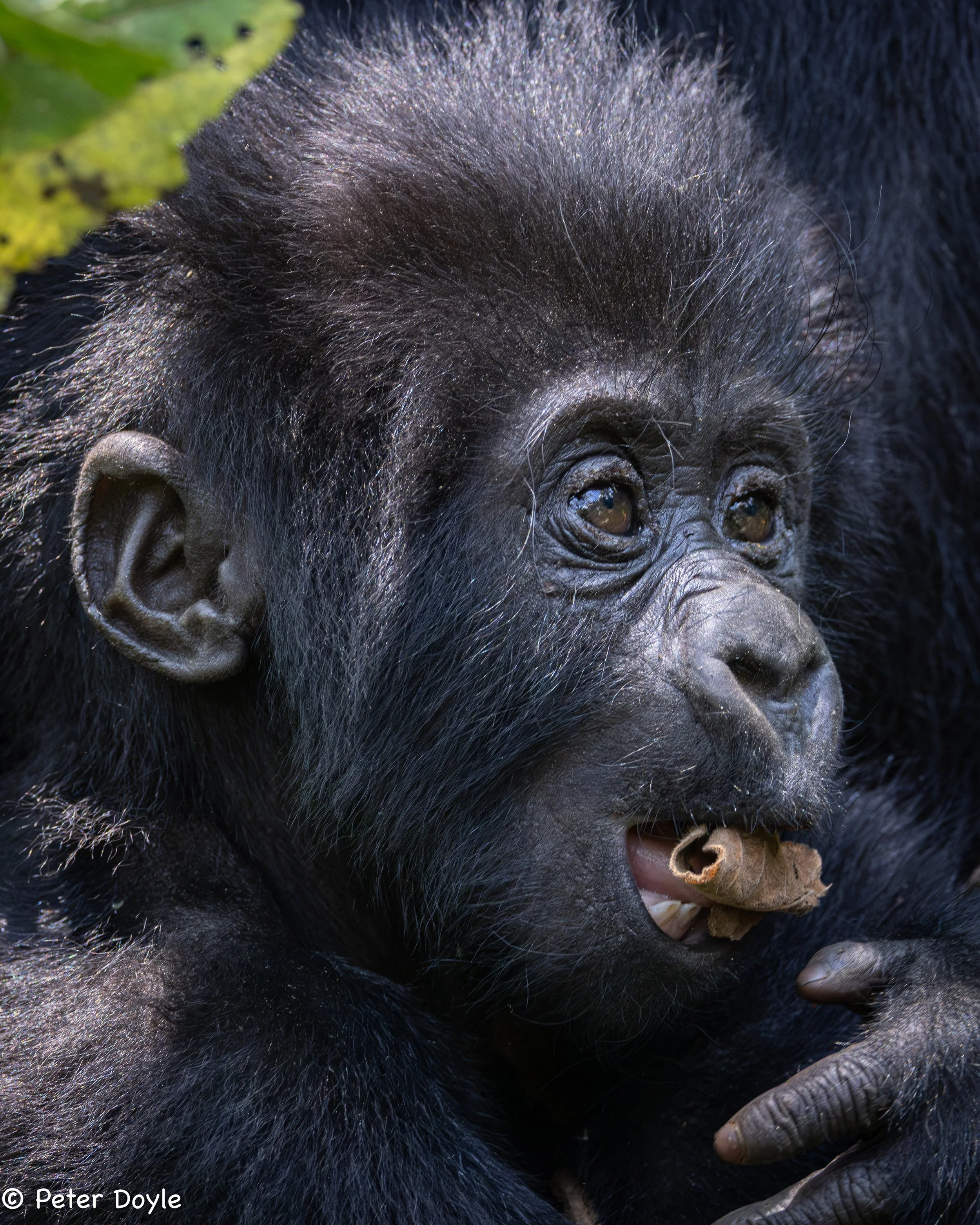
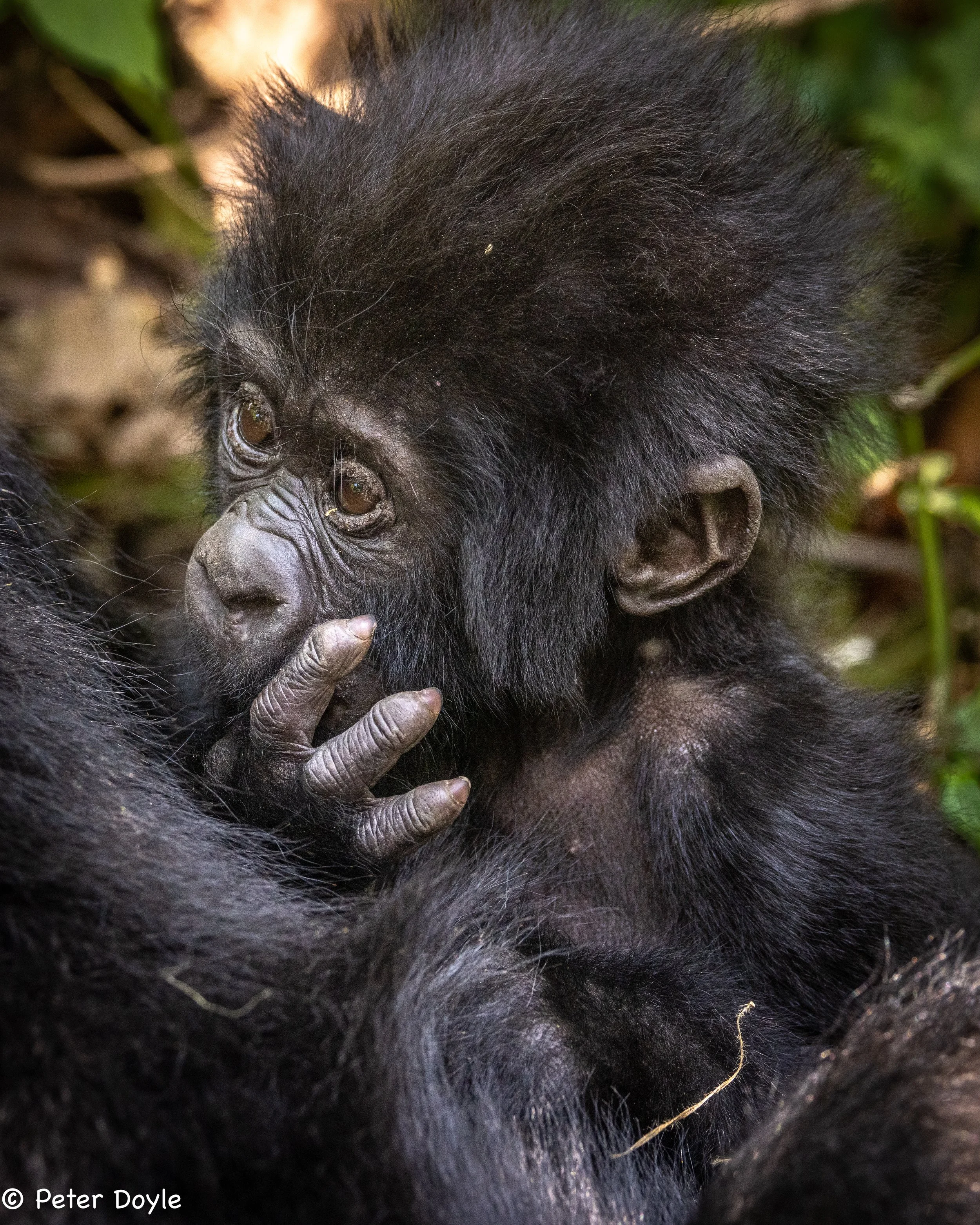
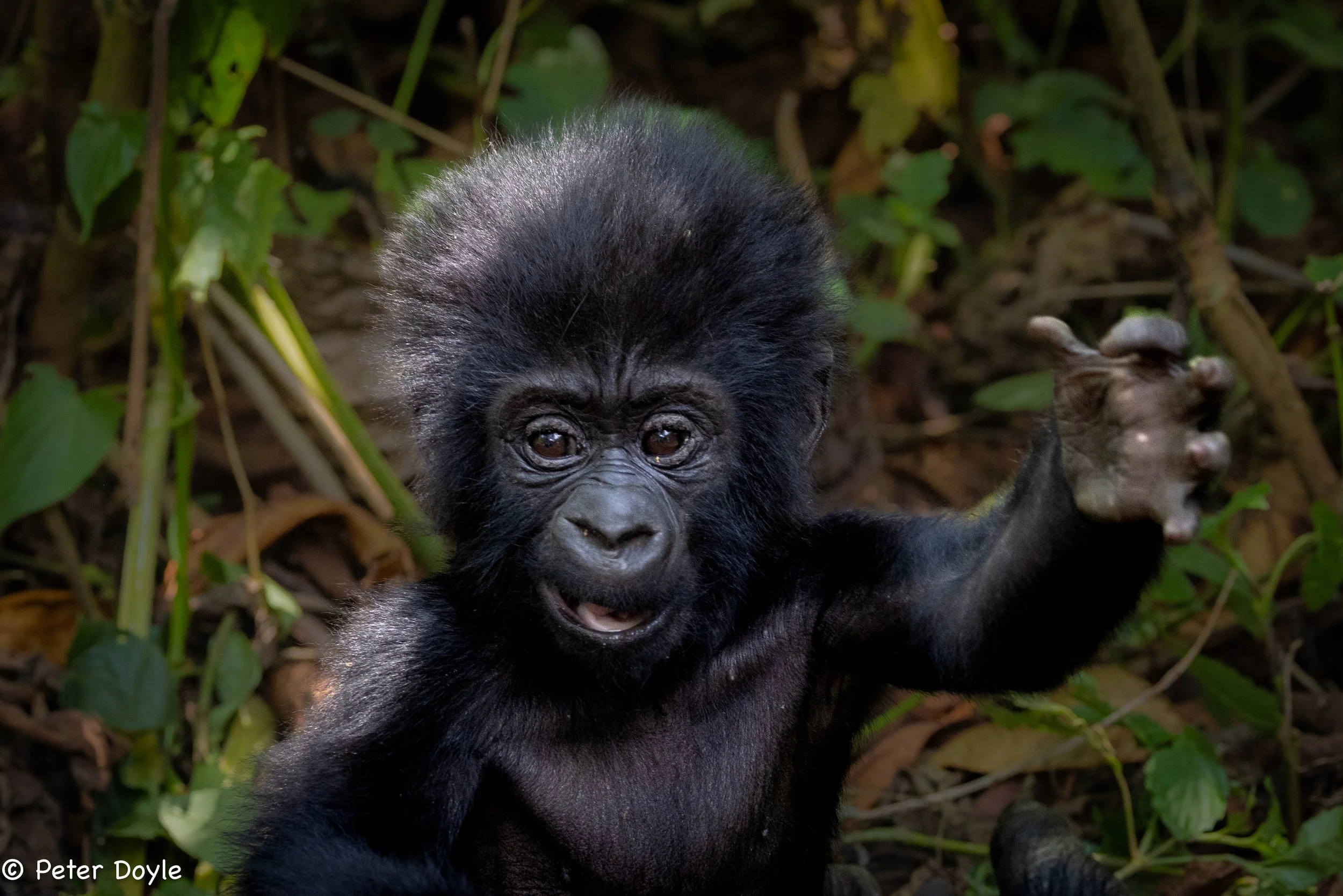
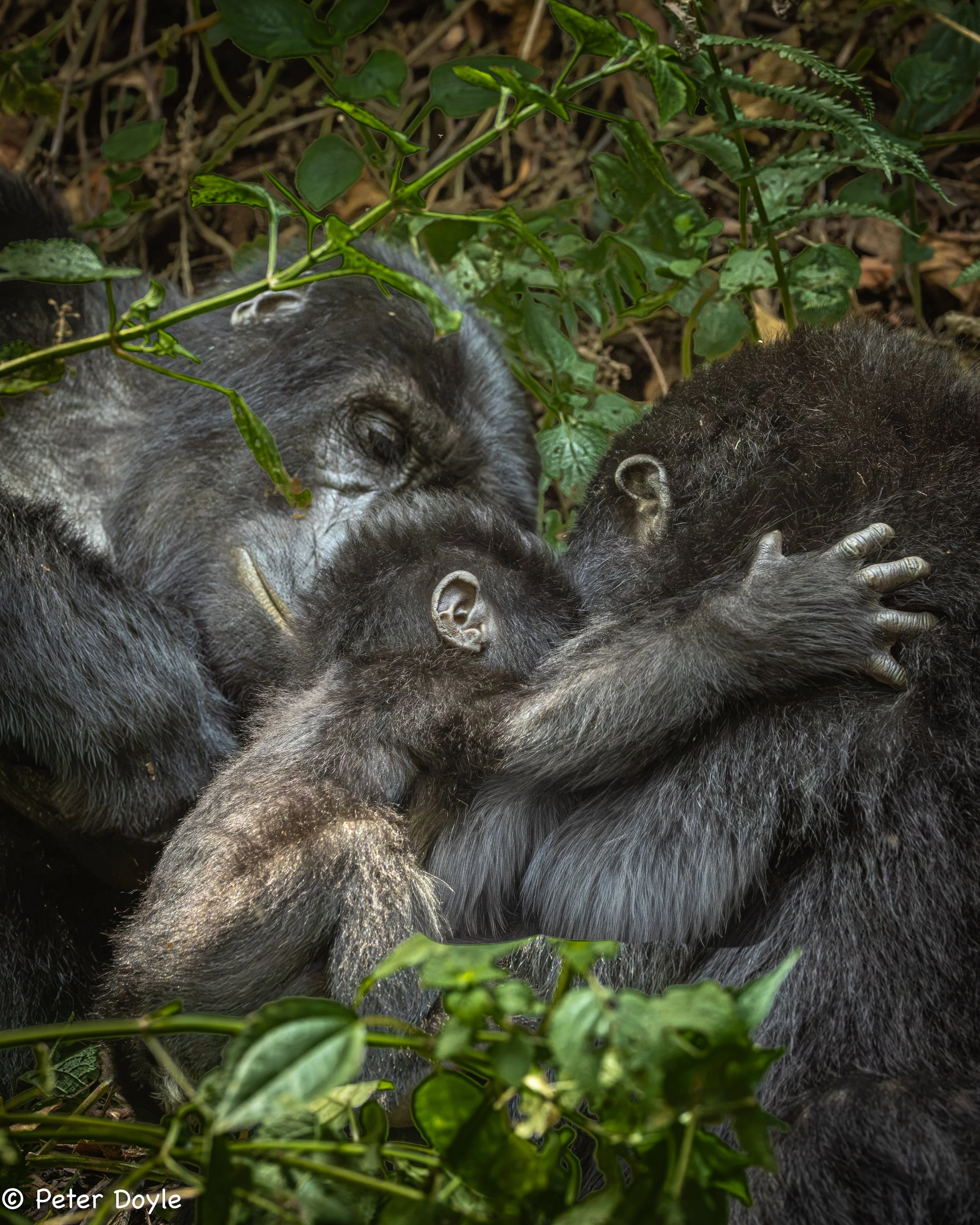
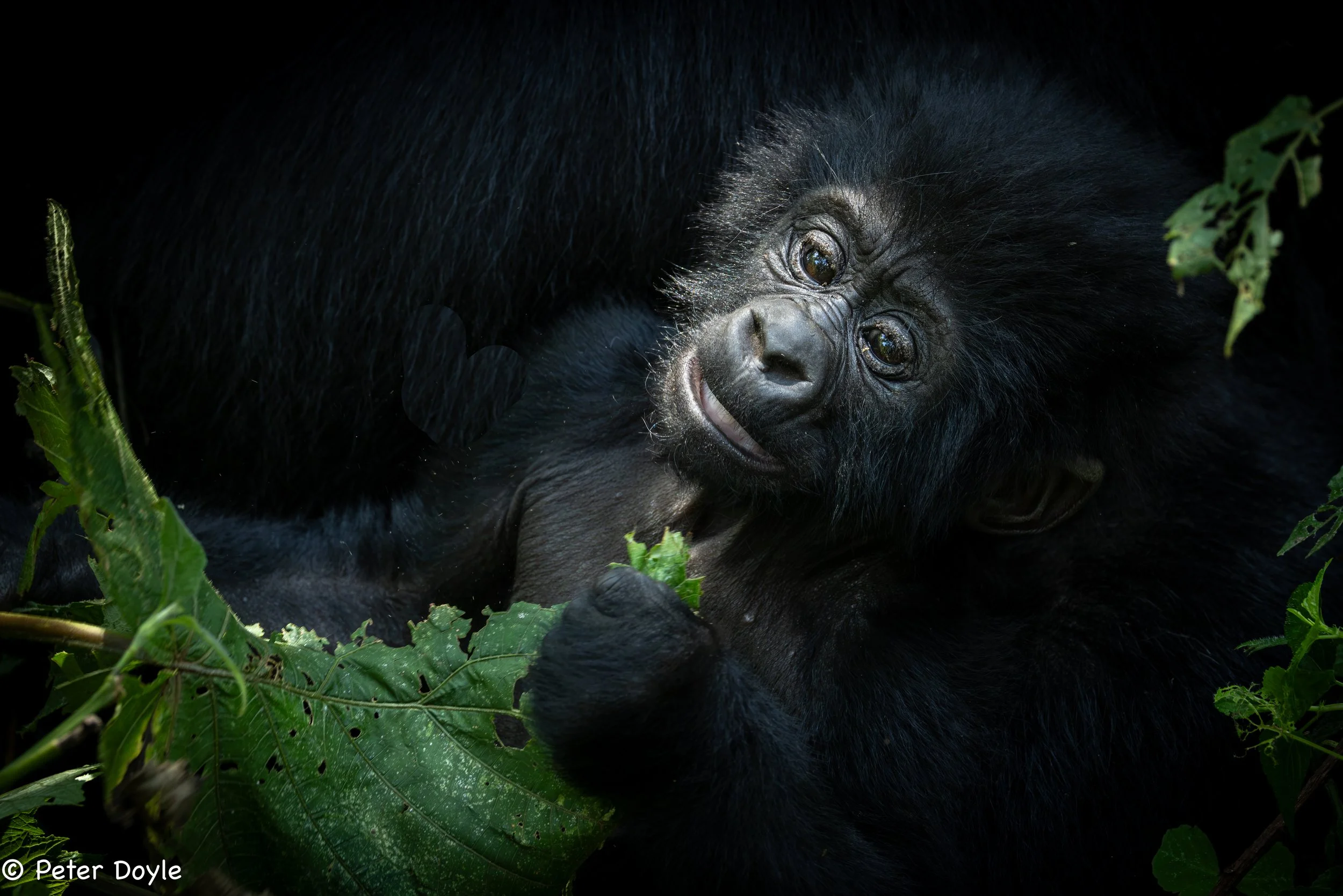
Two adult female mothers came past, each carrying a baby on their left forearms and then settled down near us. We had the best views of these females and their babies, estimated by our guide to be about 2 and 4 months old respectively.
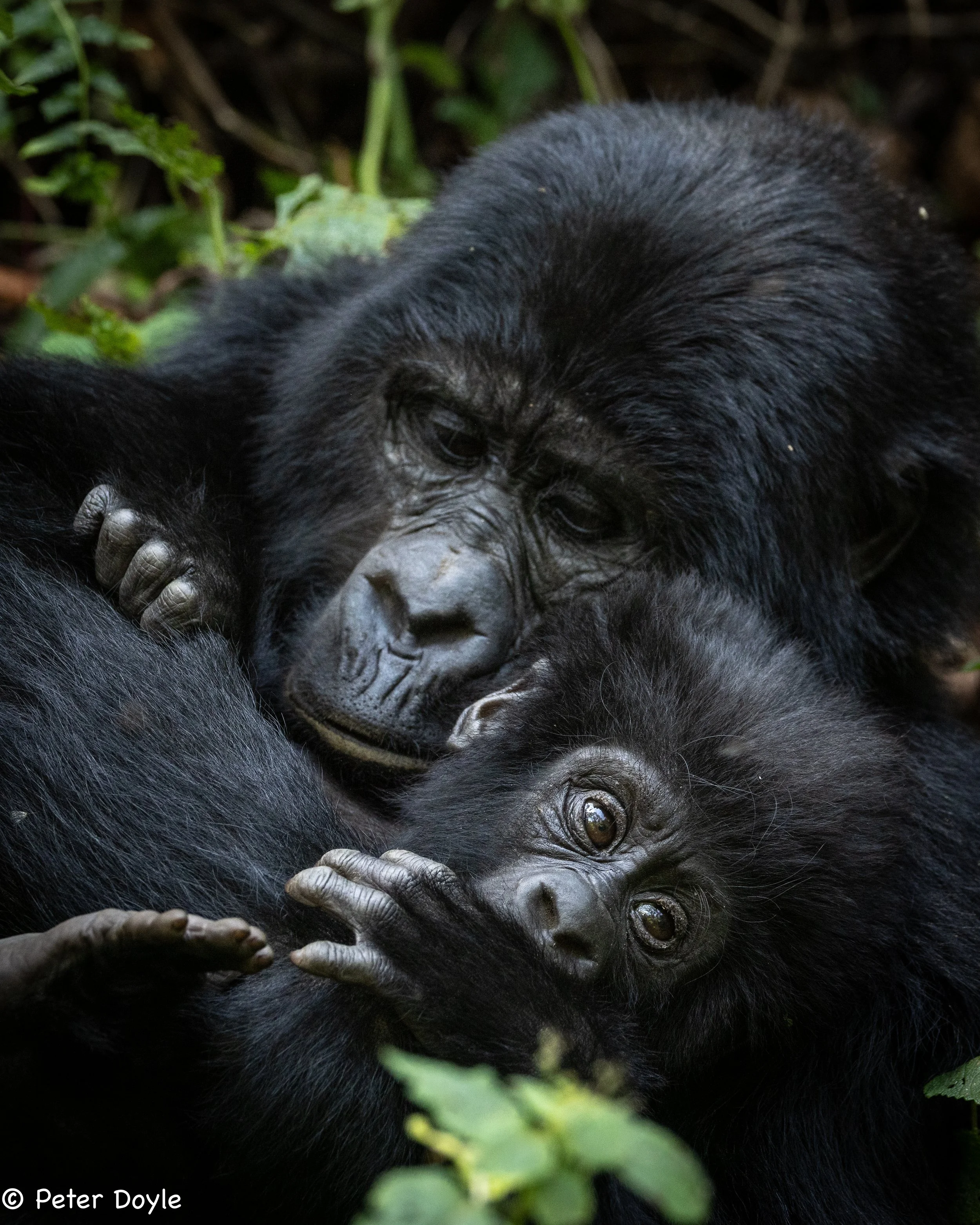
The mothers sat in the shade, breaking and eating thick, fleshy branches, mainly for their water content. Meanwhile, the babies either breastfed, or rolled around grasping at sticks and leaves, trying to, and failing to, imitate their mothers.
Quite often they were just pushed aside as the female grabbed onto a new branch and the baby had to clamber back up again. Later on, they all seemed to take a rest, and the babies snuggled in between the mother and some other adult gorillas.
All the while, the dominant Silverback male sat observing the scene, and us, making sure all was in order. It felt to me that he would quite happily tear me limb from limb, should I have done anything stupid!
Other than that, all was calm.
All too soon, Phoebe said it was time to go, and we said our farewells to the Rukara Group and then we then drifted off into the bush, just as they had come.
I don’t quite have the words, but all-in-all, it was an incredible, interesting and humbling experience … for us all, I think.
What follows are just a few of the many photo’s taken that day.
Enjoy!
Gorilla Photo Gallery
Reflection
I think we were all moved by our experience with the Mountain Gorillas.
Perhaps for different reasons; and for reasons that are not easy to express.
I felt thankful to have come so close-up and personal with them and to be able to observe such intimate family moments and behaviour.
To see both such power and tenderness in one creature.
Humankind has, both through carelessness and greed, wiped out so many of our planet’s species. We were starkly reminded that we have a collective responsibility to ensure the survival of these rare and vulnerable Mountain Gorillas.
And that is true for all other vulnerable species and habitat.
It was also abundantly clear to me that we and the Gorillas also share a common Creator.
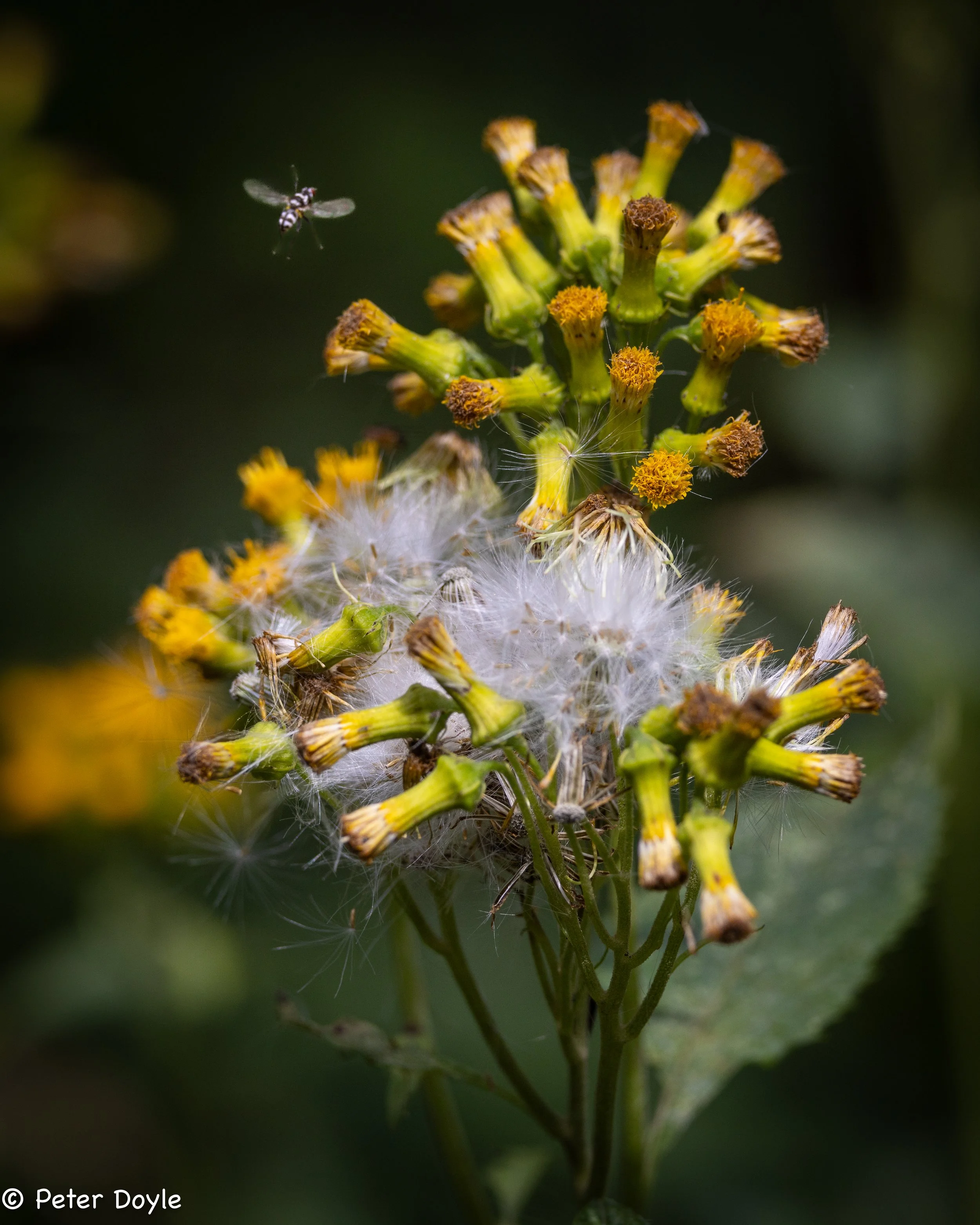
Before leaving the forest, we sat down to eat our packed lunches and chat about what we had seen. Just then, a bee came to feed on a tiny flower in front of me; just as beautiful and as precious as seeing a family of Gorillas.
The beauty of creation.
