The Nile River still evokes intrigue
For centuries, even for millennia, the Nile River has evoked feelings of mystery and curiosity about Africa.
Where does the river come from? Where does it go? Who does it pass on the way? How is its water used? Whose water is it, anyway?
For centuries explorers had searched for the source of the Nile; and the truth is, as for almost all great rivers, there is no single source. We had already been to one of the most prominent sources, Lake Victoria, which is generally agreed to the primary source of the White Nile, which then wends its way north up through Uganda and eventually into Southern Sudan.
The Blue Nile originates in the Ethiopian Highlands and, in the centre of Khartoum, the capital of Sudan, is the confluence of the White and Blue Niles, that then form the great Nile River.
Driving North
Our objective in the North-west of Uganda was to visit the Murchison Falls National Park … and the White Nile.
It was a long drive from Entebbe, firstly through parts of Kampala … but I will not write about the traffic jams! The most noticeable birdlife in Kampala were the many Marabou Storks, patrolling the wetlands and quasi-rubbish dumps on the way through the sprawling city.
We stayed overnight in Masindi, at the very comfortable Masindi Hotel.
We had three major birding experiences in the Murchison Falls NP area. Firstly, on a boat trip on the river, secondly from our vehicle driving through the park and finally on foot at the falls themselves.
A boat trip on the White Nile
I love birding from the water.
Just as in a vehicle, you can approach the birds more easily and quietly; the birds are very active near the water’s edge, feeding, fishing, preening and nesting; and, especially from a photographer’s perspective, you are seeing most of the birds at eye-level. This boat trip was no exception.
We were on a section of the White Nile, thankfully below the falls, heading towards Lake Albert. Our boat trip ended, in fact, just where the river opened up into the Lake. The river was very wide and calm and easy to navigate, and the birding was wonderful. For the first time in Uganda we started seeing large numbers of hippopotami and crocodile in the river and elephants along the banks. And primates in the trees.
Black-and-white Colobus Monkey Colobus guereza
Western Cattle Egret … with the foothills of the DRC in the distance across Lake Albert
Local fishermen
Another local fisherman: Western Osprey (Pandion haliaetus)
It was also wonderful to watch large numbers of birds flying across the river, singly or in flocks. This seemed to be a very nurturing and safe habitat for all the birds we saw,
White-faced Whistling Duck (Dendrocygna viduata)
Gull-billed Tern (Gelochelidon nilotica)
Interestingly, the epithet in its name is derived from the Latin word “niloticus”, meaning “of the River Nile”, a reference to the region where these birds were first described.
African Savannah Elephant Loxodonta africana
Goliath Heron (Ardea goliath)
Driving through the Murchison Falls National Park
Leaving the boat and the river behind, we started the drive through the Murchison Falls National Park.
We did not go far north in the park. We later discovered that Uganda has recently started to exploit an oil field in the north of the park, with a pipeline already carrying crude oil right down the length of Uganda, before crossing into Tanzania and thence to the Port of Tanga. From there it is exported to the global oil market Although we crossed the pipeline several times later in our trip, we saw no signs of it in the national park.
We did, however, continue to see new birds and mammals regularly in the park.
Common Patas Monkey (Erythrocebus patas)
Nubian Giraffe (Giraffa camelopardalis camelopardalis)
However, getting back to the birding. We finally found one of our target birds for the region, the Abyssinian Ground Hornbill. This hornbill only occurs north of the equator. It is a very slow breeder; a monogamous pair producing two chicks only every 9 years!
Abyssinian Ground Hornbill (Male) (Bucorvus abyssinicus)
We also found a new thick-knee and saw the first of the special Barbets found in Uganda …
Senegal Thick-knee (Burhinus senegalensis)
Black-billed Barbet (Lybius guifsobalito)
Murchison’s Falls
Finally it was time to visit the Murchison Falls, after which the park is named.
While not the highest, or widest, or biggest falls in the world, Murchison is nevertheless an awe-inspiring sight. It is reputed to be the “most powerful falls” in the world!
Here the White Nile is forced through a gap 7 metres at its narrowest, before dropping down over 40 metres into the raging pools below.
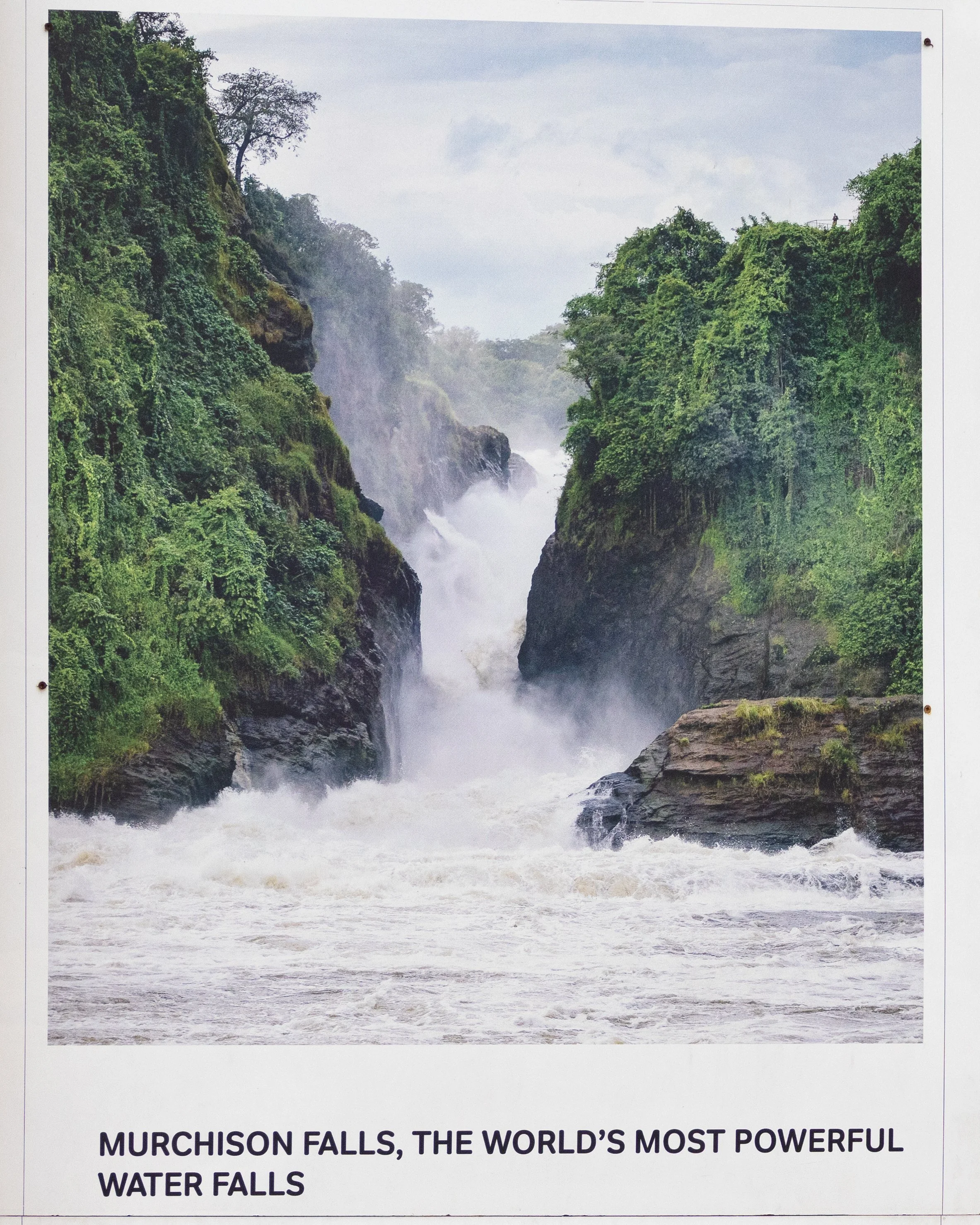
The sign at the view site says that Murchison is the “most powerful” falls in the world!
There is no mention of how this is measured, but standing near the falls, one can easily believe it.
We went to the view site at the top of the falls. The sound was thunderous and every other moment we and the falls were enveloped in clouds of spray. At times we could hardly see the river only a few meters away.
It was then that we first saw the birds … first, an African Pied Wagtail … inches from the raging river.
African Pied Wagtail Motacilla aguimp
Rock Pratincole
Then a new lifer for us … the Rock Pratincole.
These birds favour large, fast-flowing, perennial rivers. Well, the White Nile certainly meets all those criteria.
Their specific habit is rocky outcrops in these rivers. It is here where the monogamous pair can nest in the rock crevices, lay their eggs and raise their chicks safely away from predators. It does not feed on the rocks or in the river, but it hawks mostly insects in the air, often flying with Swifts and Swallows and other aerial feeders.
The Rock Pratincole is endemic to sub-Saharan African and is an intra-African migrant. While migrating, they can also be found in larger numbers and on sandy banks in the river. We have looked for them before, unsuccessfully, on the Okavango river and also on the Zambezi, which also happens to form the Victoria Falls, the other great waterfall in Africa.
Rock Pratincole Glareola nuchalis
Reflections
There is something awe-inspiring about being in such close proximity to such a great force of water.
It is loud, powerful, challenging, unstoppable, unfathomable and seemingly never-ending.
And then seeing those tiny birds, weighing about the same as a mouse, braving the water, rocks, spray and noise with ease and poise, and in a small way, it also puts into perspective how tiny we are in comparison to the world around us.
