We were blessed to do a birding and primate tour of Uganda.
August 2026.
Uganda
Uganda is known as The Pearl of Africa.
It is such an interesting country, given its unique and central location in East Africa. Uganda is part of the East African Community (EAC). It borders five of the other countries of the EAC: The Democratic Republic of the Congo (DRC), Rwanda, South Sudan, Kenya and Tanzania. The other two countries of the EAC are Burundi and Somalia.
Uganda is land-locked, has no access to the sea, and its geography is dominated by the African Great Lakes region, which forms a major part of the East African Rift. Uganda has a predominant share in three of the Great Lakes, being Victoria, Albert and Edward. Lake Victoria is the major source of the White Nile river and is also the second largest fresh-water lake in the world by surface area.
Map of the East African Community (Source: Cartovia)
Birding in Uganda is very exciting and productive, mostly because of its vast range of habitats in such a relatively small country. These habitats range from Alpine regions and Montane forests in the Ruwenzori Mountains, tropical rain forests and woodlands, vast savannah grasslands, to fresh water lakes, rivers, wetlands and swamps.
I love maps, probably because I like to know where I am and where I am going! The map above shows Uganda in the context of East Africa and its neighbours and the map below shows Uganda in more detail … and highlighted in black is our route within Uganda.
Map of Uganda (with our route marked) Source: Uganda Tourism Board
Our Guides
Our trip was organised by Nature Travel birding. Our primary guide throughout the trip was Marc Cronje, an excellent guide and friend from South Africa, with whom we had all traveled before; the rest of the enjoyable group of fellow travellers were Hilton, Matt, Di, Rainer, Ellen and myself. We got to know each other rather well on this trip, partly due to the logistics (or gymnastics?) of getting in and out of the back of the vehicle multiple times per day!
Marc is both an expert on birds as well as primates, which was really valuable, especially when we saw many of the more rare primates and when trekking to see the Chimpanzees and Mountain Gorillas.
However, especially in all the forests, rivers and swamps, we also used local guides, who were invaluable with their local knowledge and experience. As you know, much of any forest birding relies on knowing the calls … which they all did.
Finally, we had a great driver, Brian, who is also an excellent birder. He is a moderator for eBird in East Africa and was excellent with bird calls, even while driving. We ofter stopped to see a bird that he had heard as we were trundling along in the parks and he would have heard their call.
Brian also did a heroic job every day, packing the vehicle with luggage, food and people.
But first, the Shoebill
After landing at Entebbe International Airport, we spent the night at a lodge near the airport, because we had a very exciting trip planned in the morning! And that was to find the almost mythical Shoebill.
We left the lodge at 6am, after coffee and a very early packed breakfast, to catch the ferry on Lake Victoria. Firstly we drove to the Buwaya Landing Site, where we were nearly the first vehicle in the queue for the ferry, where we waited for it to return from the other side of the bay.
As the sun rose, we watched the early morning Egrets, Gulls, Cormorants, Heron, Hamerkop, Kingfishers, Wagtails, Swallows and Swifts flying, hunting and fishing around us.
Early morning Egret
Local commuters at dawn on Lake Victoria.
In the meantime, the the crowd of people, bicycles, motorbikes, trucks and other vehicles waiting to get on to the ferry gradually grew around us. After about 30 minutes, we saw the ferry starting coming back towards our landing from the other side.
Then, we first waited, fascinated, as a similar crowd of people and vehicles left the ferry, before we could go on board. The boarding was remarkably orderly, given the crowd, and the logistics of packing every vehicle on board.
We sat on benches on the top tier of the ferry, with fine views over the lake. Eventually we saw our Landcruiser make it onto the deck and soon we were off across the lake.
Our ferry of the Ugandan Road Authority
Landing on the other side of this short crossing, at the Nakiwogo Landing Site, we started to see our first new birds of this trip. Only true birders can get excited by seeing a new Sparrow, Weaver or Chat. We saw all of these: A Northern Grey-headed Sparrow, a group of nesting Northern Brown-throated Weavers and a pair of Sooty Chats.
This was proving to be a great start of our trip in Uganda.
But the main objective today was the Mabamba Swamps, most famous, among birders at least, as the home of a large population of the rare and almost mythical Shoebill.
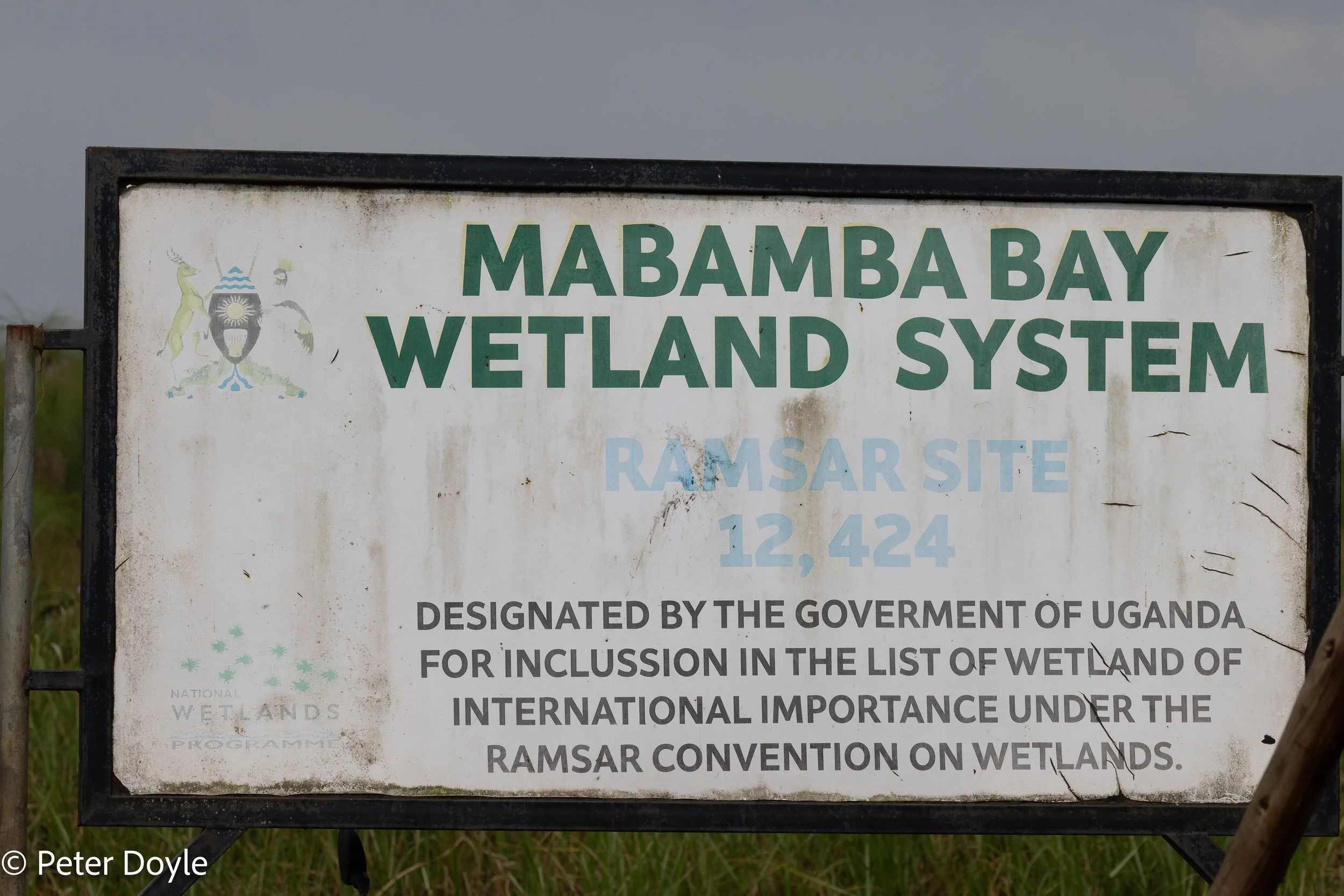
A RAMSAR site
After a short drive from the ferry, we arrived at the Mabamba Swamp boat launch site. Before we went on the narrow wooden boats, we were shown a Lungfish, the primary diet of the Shoebill. They have sharp teeth, so beware!
African Lungfish
The best way to find and see the Shoebill is on the narrow wooden boats that take you through the channels among the papyrus wetlands.
On the lookout for Shoebills
It was fortunate that we did not meet any hippopotami; but we did see our first wetland lifer: a beautiful little Swamp Flycatcher.
Swamp Flycatcher Muscicapa aquatica
Almost inevitably, we saw a splendid Malachite Kingfisher …
Malachite Kingfisher Corythornis cristatus
…. and probably the most beautiful of the Lapwings, the Long-toed Lapwing.
Long-toed Lapwing Vanellus crassirostris
But, however beautiful these birds were, we were most excited about the possibility of seeing a Shoebill. That was why we were in the Mabamba Swamps and, for some of us at least, why we were even in Uganda.
Quoting eBird about the Shoebill:
“Utterly unique bird that makes up its own family. The plumage is uniformly gray in adults and brownish in immatures. Structure is stork-like overall, but with a thick neck and massive hooked bill. In flight, which is sometimes quite high, the long legs trail. Found in deep marshes, especially papyrus swamp. Usually alone or in pairs.”
Furthermore, the Shoebill (Balaeniceps rex) is endemic to tropical and central East Africa. Its primary range is from Southern Sudan, Uganda, eastern DRC, Tanzania and a somewhat isolated range in central Zambia. Shoebills are listed as Vulnerable on the IUCN Red List.
At last, as we came around a corner of one of the channels, we saw our first Shoebill. To top it all, this was a female, on a nest, with a chick. Many photographs were taken as we nudged the boat closer, but still keeping a respectable distance away. Clearly the boat guide knew this nest was here, but that did not spoil the excitement of seeing our first “prehistoric-looking” bird.
Shoebill (Balaeniceps rex)
A word here about “prehistoric”. The Shoebill is talked about as being prehistoric, probably because of its appearance being similar to how we like to think dinosaurs may have looked; and also It being the only living member of its own family (Balaenicipitidae). But, in reality, all birds are pre-historic, i.e. existing before written human history. Even the Bible, one of the oldest manuscripts in existence, has many references to birds species that we know today.
But seeing this bird up close and personal was a very special experience. It is really like no other bird on earth.
On one occasion, we did get the “death stare”, but there was no aggression behind it. We did get a good look at that fearsome bill, though … probably the last thing seen by many a lung-fish!
Later on, we got to see several other of the Shoebill. It helps to see them in the clearings between the papyrus, because although the are up to 1.4m tall, the papyrus is generally taller and they do not tower over their surroundings.
The adults have uniformly bluish-grey plumage and the juveniles are darker brown. It is, however, very difficult to tell the sexes apart in the field, other than by observed behaviour.
And another adult showing off its wings …
We also saw one Shoebill taking off and another in flight and coming down to land. They are surprisingly strong and high flyers, for birds that weigh about 5 kilograms.
Shoebill in flight
There are about 5000 Shoebill still in the wild in Africa, and on this day we were blessed to see quite a few of them. Truly a remarkable bird. This was a fantastic start to our first day in Uganda.
Leaving the Swamps
The swamps were not done with us yet.
Firstly we saw one of the new (to us) and very beautiful Bee-eaters.
Blue-breasted Bee-eater Merops variegatus
We did see a Lesser Jacana and managed to photograph a tiny, exquisite African Jacana chick, which is often mistaken for a Lesser Jacana. The coloration and markings are different, and this chick was in near proximity an adult African Jacana. That is a give-away, because the adult African Jacana always seems to chase the Lesser Jacanas on sight.
The adult Lesser Jacana is distinguished by a shorter bill, rufous crown and no trace of the blue frontal shield of the African Jacana. The Lesser Jacana is also materially smaller, being 16cm compared to the 24 to 32 cm of the African Jacana. So the Lesser Jacana is closer in size to the African Jacana chick … see the photos below in comparison to the water lily flower … but is clearly an adult bird.
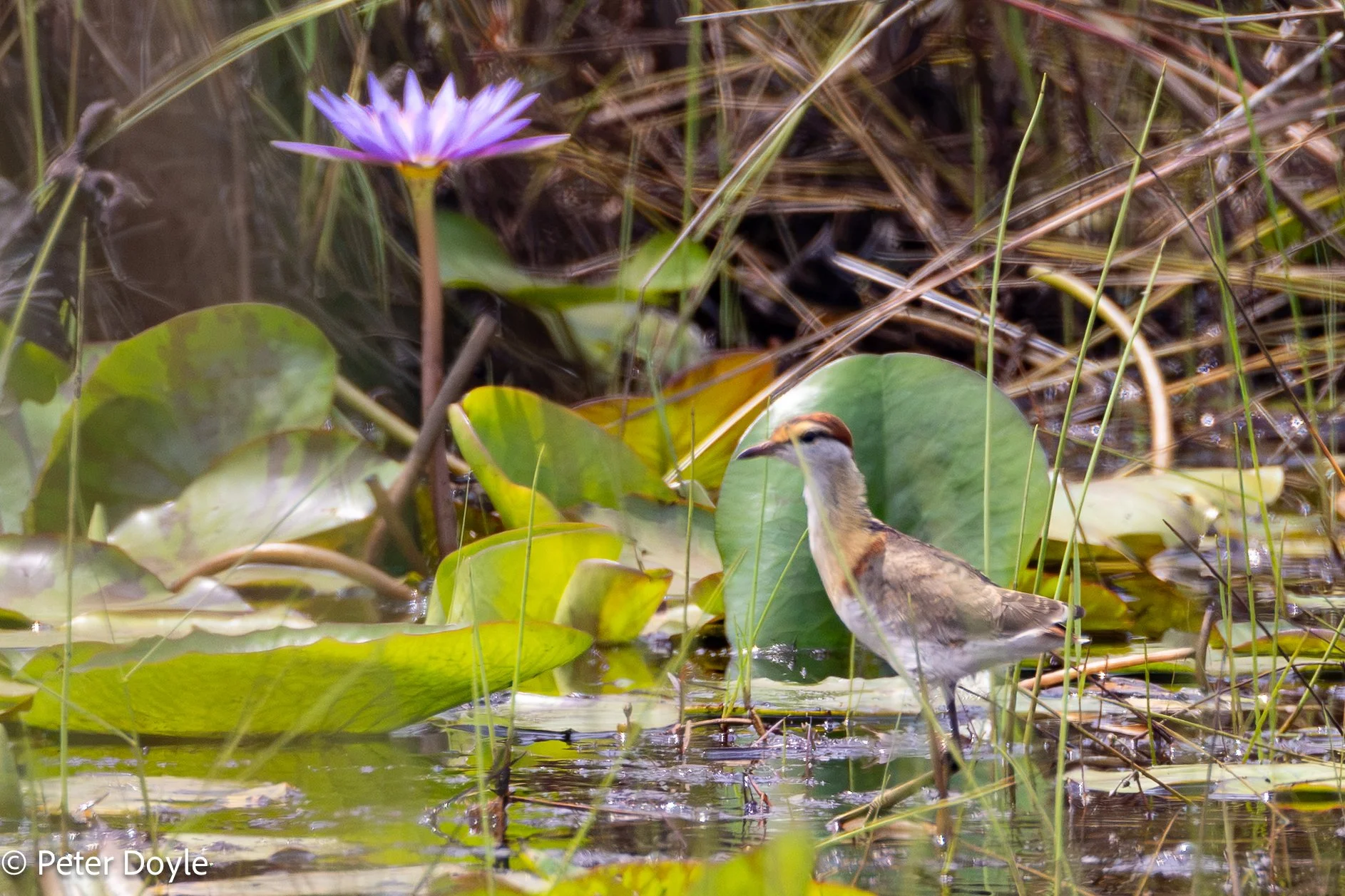
Lesser Jacana Micoparra capensis
African Jacana (chick) Actophilornis africanus
We had a successful first day in the swamps!
